
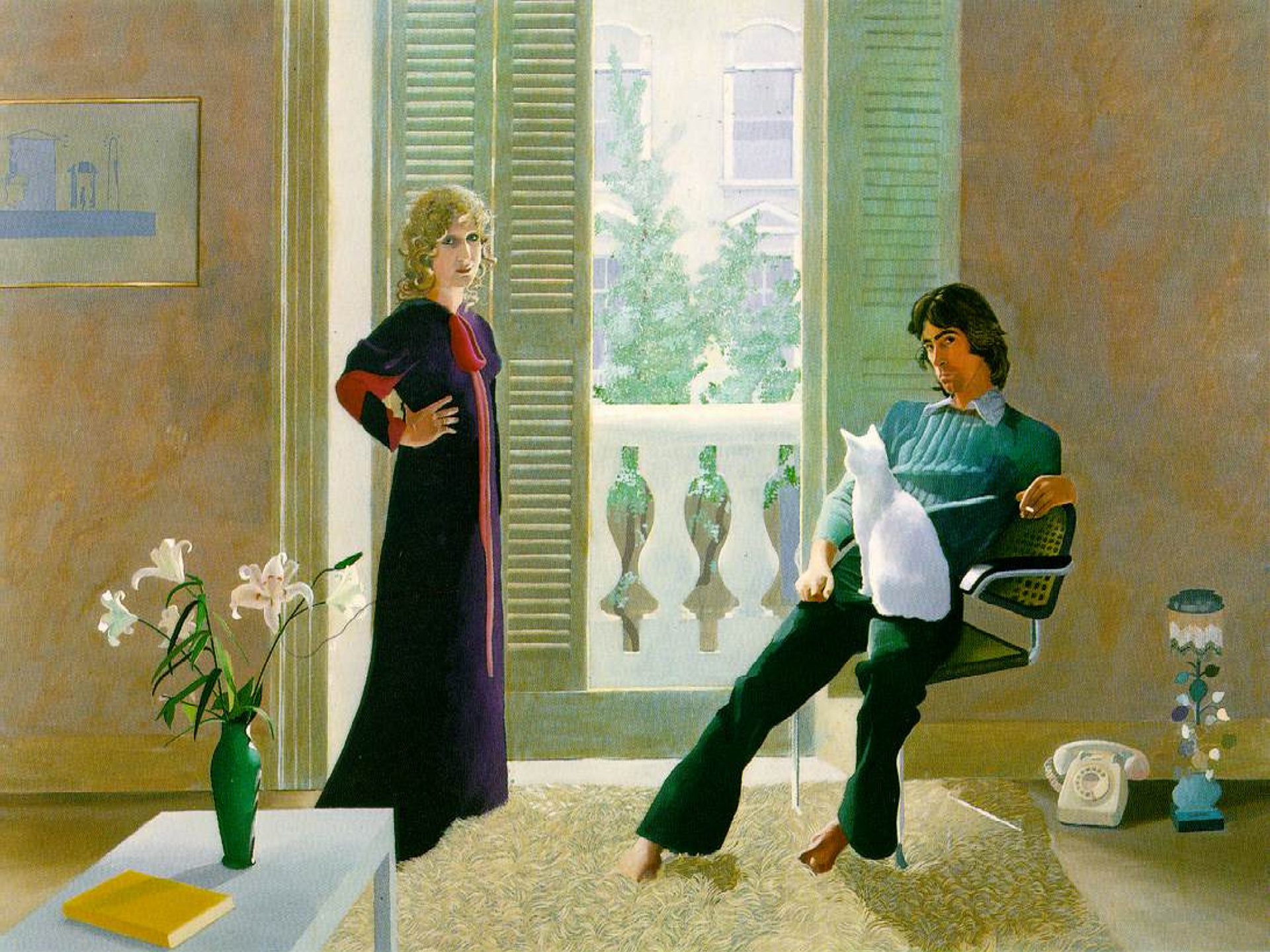
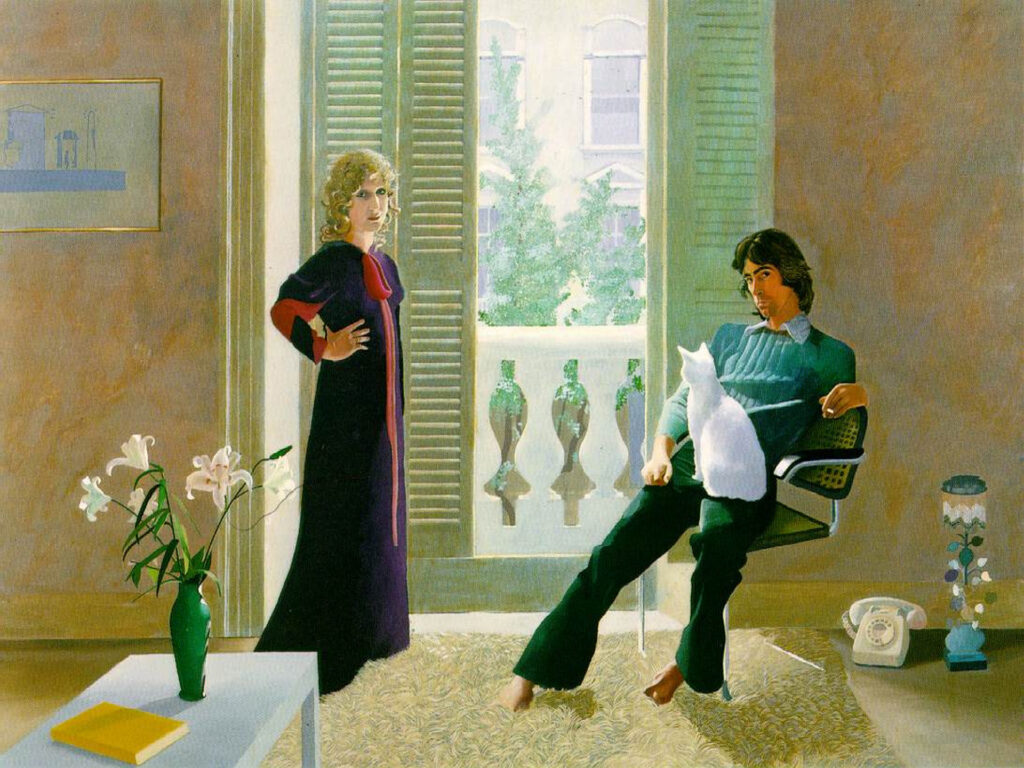
At around eight years old, my primary school teacher decided to open the doors of our perception to gallery art, choosing David Hockney’s Mr and Mrs Clark and Percy as her gateway drug of choice.
The painting appeared, at first glance, to be just a polite domestic scene — a couple poised in their London flat, a white cat on the table, daylight filtering through gauze curtains. But what struck me wasn’t the composition or the brushwork. It was the beige telephone.
The same kind of phone hung on the wall at home — a dull, plastic fixture with a coiled cord forever tangled from being stretched across the kitchen. And there it was, immortalised on canvas. That small shock — the realisation that something so ordinary could exist within the sanctum of “fine art” — quietly rewired my understanding of what art could be. Until then, art seemed a distant, exalted category: ancient portraits in gilt frames, mysterious landscapes, things made by people long dead. But here was something I recognised — contemporary, familiar, mundane. The boundaries between art and life began to blur. Hockney’s painting didn’t just depict a domestic interior; it dignified it. It made the everyday visible.
Looking back, that moment might have been my first real encounter with what Roland Barthes would call the punctum— the small detail that pierces the viewer, opening a personal connection that transcends the artist’s intention (Barthes, 1981). For me, the beige telephone was the punctum that punctured the myth of art’s distance. It was the bridge between my lived reality and the constructed world of representation.
In many ways, that early revelation has quietly shaped the way I approach visual communication and design today
Whether I’m working on an editorial layout, a digital interface, or a spatial graphic, I’m still chasing that moment when the familiar becomes newly visible — when a detail, colour, or typographic choice reframes the ordinary and makes it matter. Design, like Hockney’s painting, is not just about beauty or clarity; it’s about recognition. It’s about that electric moment when someone sees themselves — their world, their tools, their language — reflected back at them with new significance.
Looking back now it’s easy to state that Hockney himself was fascinated by how technology mediates perception — from the Polaroid collages to his experiments with iPads and digital drawing. That beige telephone was a harbinger of this fascination. It symbolised communication, connection, and the quiet hum of modernity. It was a domestic object that hinted at a larger network — a world where art, technology, and everyday life were increasingly intertwined.
For an eight-year-old, of course, none of this was conscious
I simply felt that art had suddenly become real. It wasn’t about marble busts or mythological scenes anymore. It was about us. The fact that a phone — our wall-mounted phone — could sit in a painting felt like permission. It gave me a sense that art wasn’t something external to life, but something threaded through it.
Years later, when I look at Mr and Mrs Clark and Percy again, I see more than a domestic portrait. I see the origins of a lifelong curiosity about how images operate — how they persuade, connect, and construct meaning from the textures of the everyday. That beige telephone, sitting modestly in the corner of Hockney’s frame, continues to ring — a quiet reminder that art often begins not with grand gestures, but with the objects we overlook.
References:
Barthes, R. (1981) Camera Lucida: Reflections on Photography. Translated by R. Howard. New York: Hill and Wang.